Authenticity: An Editing Process

Everyone says “Be authentic,” but what does that actually require? What does that even mean?
We speak about authenticity as though it is something a person eventually reaches, as though after enough honesty, enough loss, enough thought and experience, there comes a version of the self that finally holds still. Now we are “authentic,” and we get a little badge to pin to our chest that says “Authentic.”
You hear it all the time. Just be authentic.
I think part of me keeps hoping for that. The little gold star that says I've made it to some authentic place. Some place inside yourself where you finally stop shifting under your own feet. A point where what you want, what you value, what you can tolerate, what you are building, and who you understand yourself to be all sit together long enough that you stop revising yourself against your own life.
I have wanted that more than once. I still do, if I am honest. A girl just wants to make it to the pinnacle of authentic existence, you know?
There is something deeply, delusionally reassuring about imagining that if you think hard enough, survive enough, pay enough attention, make tough choices and “follow your heart” that eventually you arrive at a version of yourself that no longer needs such regular revision. You are just authentically you, suddenly.
Life has never really been that way for me.
What feels more true is that clarity keeps moving... and that living in authenticity demands re-meeting yourself, your values and desires- over and over again. Not in an obvious way everytime, not in a way that makes identity meaningless, but with enough weight that something once sincerely right can begin to feel incomplete. A desire can carry you faithfully for years and then, almost imperceptibly, stop holding the same weight. A life can still look reasonable while no longer feeling entirely inhabited from the inside. And when it has shifted, you know. You freaking KNOW. But then what? I'll get to that soon.
I am trying to stop assuming that revision means fraud. That change suddenly steals from being authentic.
Carl Rogers was interested in what happens when a person’s inner life and outward life drift too far apart. He called the healthier state congruence: not perfection, just enough alignment that what you privately know and publicly live are not constantly fighting each other. The longer that split remains, the more strain a person tends to carry, often without naming it clearly.
What stays with me is how often a life can continue functioning while something underneath has already begun asking for revision. The problem usually begins when we ignore that call for change and chalk it up to feeling like sh*t for no reason. So, back to the question: you know something needs to change, now what?
The “Bridge”
The hardest part has rarely been the moment of knowing for me. I think, often, we know more than we admit. What costs more is everything that comes after knowing and before movement.
That stretch of time where something in you has already changed, but your life is still arranged around the version of you that existed before. You are suspended between what was, what you know now, and what your life has not yet caught up too. The life you are not allowing yourself to live yet but know that you want.
I have lived there longer than I should have more than once. Long enough to know a person can lose an enormous amount of energy there while still appearing completely functional, until eventually even that function starts thinning out.
Awareness does not automatically create courage. It definitely does not automatically create clarity. Just because you know something does not mean you suddenly have the tools to move toward what that knowing requires.
Sometimes all awareness gives you is the uncomfortable realization that what used to fit no longer fits, while everything around you still looks intact enough that leaving feels unreasonable. You still know how to perform the old life. You know the rhythm of it, the practical language of it, the obligations attached to it. Nothing has visibly collapsed, so remaining where you are begins to sound intelligent.
That is exactly what happened to me with work years ago. I stayed in a job too long because leaving would have forced a question I could not answer yet: if not this, then what? The job was good in many ways. Stable. Legible. It gave me something clear to point to, which almost made leaving harder, because when something is obviously terrible, the mind has less room to negotiate. But when something is decent while slowly becoming misaligned, staying starts sounding like discipline even when it is avoidance.
What I knew privately was harder to admit: the work no longer felt right for me the way it once had. The alignment was gone. The integrity I needed from it creatively, internally, even ethically, no longer felt fully intact. I was growing out of the experience.
But because I could not yet see what came next, I stayed. I didn't want to experience growing pains or betting on myself. And staying cost more than I understood while I was in it.
It did not break me down all at once. It showed up in fragments. I stopped taking care of my body the way I usually do when I feel like myself. My mind became busy and noisy. My relationships took on the tone of someone internally tired long before I admitted how tired I was.
I was still functioning, which almost made it harder to respect how unwell I was becoming. Nothing really dramatic had happened. I was still answering emails, still meeting obligations, still technically participating. Not with excellence, but enough to keep calling it fine. But, I was chronically exposed to being done with my life and chronic exposure can be sneaky.
I became so consumed by being over the life I was living that I slowly disappeared inside my own frustration. I was there, technically, but I was no longer fully present. So much of my attention was being spent negotiating internally with a life I already knew I did not want in the same way.
That leaks your energy. It leaks into tone, into patience, into how much room you have for other people. It steals from how much capacity you have to move forward.
Without fully realizing it, I was taking that exhaustion out on people around me. Less softness. Less delight. Less capacity to enjoy what was still good because so much of me was preoccupied with what I could not stop circling.
And it became the thing I talked about constantly. The same frustration. The same loop. The same circling. At some point I was no longer especially enjoyable to be around because I was no longer fully in life. I was standing beside it, narrating why I could not move.
When Thought Becomes Rumination
Psychology calls one version of this rumination: thought that circles without landing. Not reflection, not insight, just the same internal path worn deeper each time you walk it, like animals wearing down a fence line, pacing the same route until the ground itself gives way beneath them.
Researchers, especially Susan Nolen-Hoeksema, linked rumination strongly to depressive symptoms because the mind remains active while nothing actually resolves.
That is exactly what it felt like in hindsight. I got low-grade depressed. I was living out of alignment. I was not being authentic. I was narrating a problem my body had already begun asking me to solve… and I was not solving it.
The image that still feels most accurate is a pebble inside a glass bottle. At first it seems harmless enough. A small thing moving in circles. You spin the bottle. The pebble moves in circles perpetually. Ruminating, if you will.
But keep spinning it long enough and the structure weakens. Tap the glass and suddenly it shatters somewhere that seems disproportionate to the force.
The same thing happens in an unresolved life. Eventually you become so worn down by your own lack of movement in the right direction, running in circles in the old one, that something seemingly small breaks everything open. Then ironically, change arrives anyway. Not because you chose it, but because life eventually refuses to let you remain suspended forever.
Why We Cling So Hard To Who We Have Been?
Sometimes I think I do not resist truth because I can't see it. I resist it because truth threatens the life I built to survive an earlier chapter or maybe I actually feel comfortable enough in the life I have. It's “good enough.”
I think one of the least acknowledged obstacles to authenticity is how deeply attached we become to our own continuity, not just socially, but inwardly.
We cling to versions of ourselves because those versions explain us back to ourselves: the person who chose this path, the person who built this career, the person who wanted this kind of life, the person who tolerated that much, the person who believed those things.
Once a version of self has carried you through years of decisions, routines, sacrifices, explanations, and relationships, letting it loosen can feel far more threatening than people admit.
Because if that identity is no longer fully true, then old decisions suddenly need to be reread. Old sacrifices take on new light. Old certainty becomes harder to defend.
Sometimes it is not that a person cannot hear what is changing. It is that hearing it means admitting the person who wanted yesterday’s life may not be the same person standing here now.
And there is grief in that.
William James argued that the self is larger than personality. We attach identity to work, relationships, reputation, habits, even the stories we tell about why our lives look the way they do. Which means changing one part of life rarely feels like changing one part. It can feel like disturbing the entire explanation.
That explains why people cling even when they know something no longer fits.
A job is never only a job once it has become part of how you explain your worth. A relationship is never only a relationship once it has become part of how you imagined your future. A long-held dream is never only a dream once years of effort have been organized around it.
We cling because identity offers coherence, and coherence often feels safer than freedom.
Søren Kierkegaard wrote that possibility carries its own dizziness. Not because freedom is automatically beautiful, but because once you realize you could become something else, staying where you are stops feeling accidental and more like a choice. Then beyond that, the freedom of choosing your next “life” becomes incredibly daunting.
That is where authenticity often stalls. Not because truth is absent, but because old identity still offers something the next version cannot yet offer: familiarity.
What If Authenticity Is Not Arrival At All?
There is also a real pressure of remaining understandable, palatable, familiar.
Once people know you in one shape, there is often an unspoken expectation that you will continue making sense in that shape. We do this to ourselves too. We begin relating to previous versions of ourselves almost like signed agreements: I chose this. I built this. I worked hard for this.
So when something shifts, it can feel suspicious internally, as though changing your mind means you were false before.
But a previous self can be sincere and still incomplete.
Friedrich Nietzsche wrote constantly about becoming rather than being, about how a human life is not one fixed identity but an ongoing process of outgrowing previous certainties. What I take from that is simple: remaining loyal to old certainty can become its own kind of avoidance when life is already asking something else of you.
And sometimes that shift costs people.
Some people love the version of you they first learned how to rely on and feel unsettled when that version loosens. But there is information in that too, because the people who remain close while you become more truthful usually reveal something important: who is capable of loving a living person instead of a fixed role.
Cognitive dissonance gives language to why staying too long in contradiction becomes exhausting. It refers to the mental strain that appears when actions, values, and internal knowing stop agreeing.
The mind prefers coherence, so when a person continues living one thing while privately knowing another, that tension often appears as fatigue, irritability, dullness, rationalizing, over-explaining, and the strange feeling that ordinary days require too much energy.
That does not mean every discomfort is a signal to overturn your life. It only means I no longer underestimate what prolonged contradiction can cost.
Eventually I had to admit that fear of not knowing what came next in my career had kept me suspended in a place already taking more from me than uncertainty might have.
The jump looked frightening because it meant losing what I understood. Ironically though, staying in the old life had already started costing me… myself.
Maybe authenticity is less concrete than people make it sound. Maybe it is simply the point where pretending not to hear yourself becomes harder than changing things.
Often it sounds ordinary: this no longer fits. This drains more than it gives back.
I am missing myself in this.
I know this, even if I do not yet know what to do with it.
And perhaps most importantly, the possible key to being authentic: I can trust myself to do what needs to be done.
Maybe authenticity is not flawless execution of every truth you uncover. Maybe it is the willingness to stop negotiating against what you already know and move forward without full answers.
I still want certainty more than I admit. I still want a version of life that explains itself and stays explained.
But what feels the most true to me now is that the self does not arrive once and remain there. It asks again. It asks differently. It asks for revision.
Maybe all we can really do is keep building the skill set required to meet that moment well. Keep gathering tools. Keep strengthening whatever in us knows how to tolerate uncertainty, make decisions, survive discomfort, begin again, and trust that we can live inside what comes next.
Because when change finally knocks, and it always does… confidence rarely comes from certainty. It comes from knowing you have lived enough to carry yourself forward, even before you fully understand who you are becoming.
Whatever peace exists in us seems to belong less to suddenly becoming authentic and more to answering the call of change when it comes.
And then doing it.
Authenticity, to me? Hearing your own inner voice, stepping onto the bridge between what is and what will be, allowing your life to be editted- then having the courage to cross the bridge into the unknown.
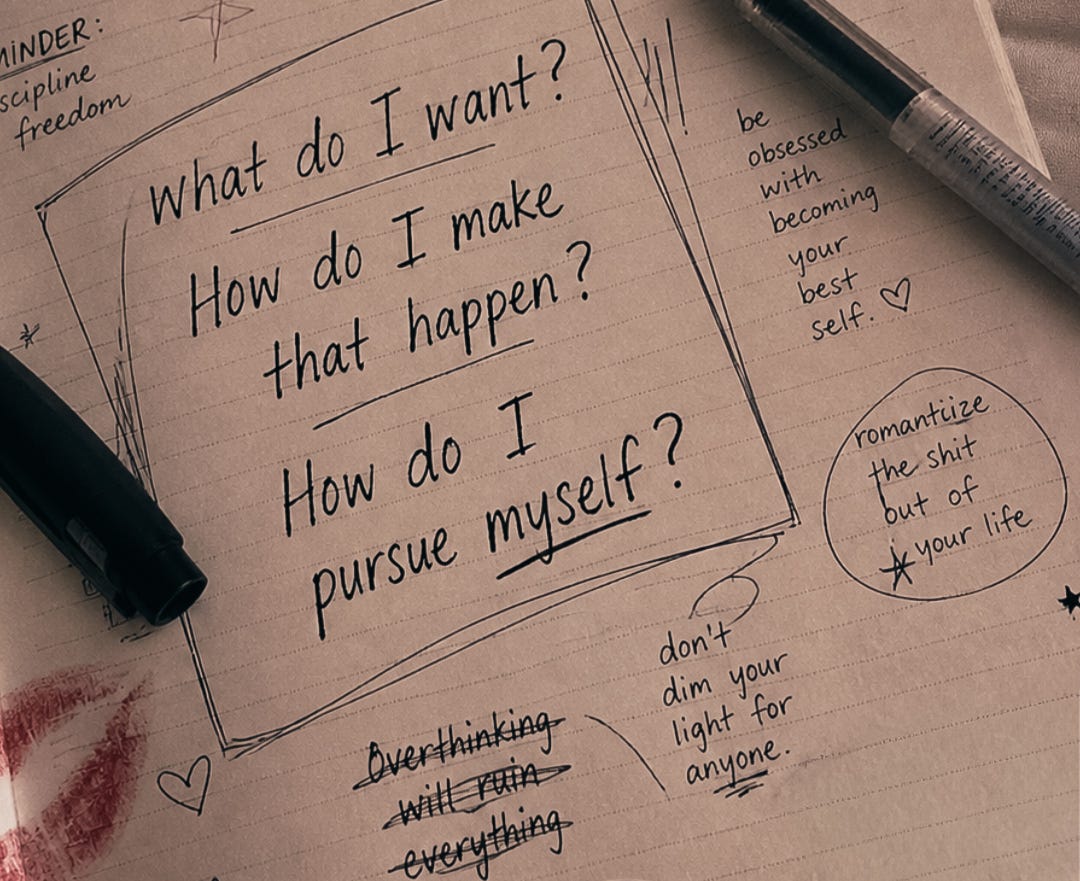
love this!!
Recommended .. have to ..awesome ...